This glossary will contain the different types of concrete for construction.
Air-entrained concrete
noun
Air-entrained concrete contains billions of microscopic air cells per cubic foot. These air pockets relieve internal pressure on the concrete by providing
Example: The air content of concrete is made up of entrained and entrapped air voids. Entrained air refers to microscopic air bubbles intentionally incorporated into concrete during mixing, usually by use of a surface-active agent.
en: Concreto con aire incorporado
Architectural concrete
noun
Architectural concrete is concrete that will be permanently exposed to view and therefore requires special care in selection of the concrete materials, forming, placing, and finishing to obtain the desired architectural appearance.
Example: concrete used for the exterior or interior ornamentation or finish of a building or structure
en: hormigón arquitectónico
Asphaltic concrete
noun
Asphalt concrete means a composite material consisting of asphalt binder and mineral aggregate that is mixed together then laid down in layers and compacted.
Example: asphalt, black or brown petroleum-like material that has a consistency varying from viscous liquid to glassy solid.
en: hormigón asfáltico
Cellular concrete
noun
concrete made with hydraulic cement, water, and preformed foam to form a hardened material having an oven-dry density of 50 pounds per cubic foot (PCF) or less.
Example: Cellular concrete provides structure, insulation, and fire and mold-resistance.
en: hormigón celular
Colored concrete
noun
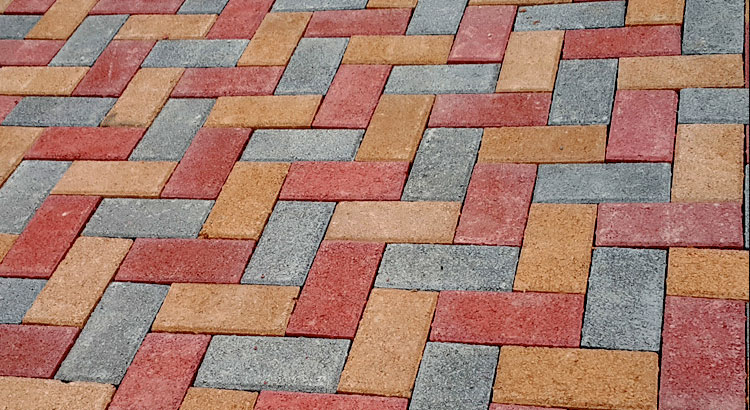
Colored concrete, also known as decorative concrete, allows traditional grey concrete to be stained and dyed different colors. Concrete has been colored as far back as the early 1900s and was primarily used by companies who made precast structures for building facades.
Example: Concrete can be colored in four different ways: stains, integral pigments, color hardeners and dyes.
en: hormigón coloreado
Cured concrete
noun
Is when the concrete has applied the process of maintaining adequate moisture in concrete within a proper temperature range in order to aid cement hydration at early ages.
Example: Proper curing techniques for Cured concrete will prevent in-situ concrete from drying, shrinkage, and/or cracking.
en: concreto curado
Exposed concrete
noun
Exposed concrete refers to concrete whose surface is a visible part of the architectural and interior design of the building. Strictly speaking, this refers to concrete surfaces that were in contact with the formwork shell when they were produced.
Example: The cost of exposed aggregate concrete is double the amount you would pay for standard concrete.
en: hormigón visto
Green concrete
noun
Green concrete is defined as a concrete which uses waste material as at least one of its components, or its production process does not lead to environmental destruction, or it has high performance and life cycle sustainability.
Example: The ingredients for making green concrete mainly consist of recycled waste materials.
en: hormigón verde
Insulating concrete
noun
Insulating concrete forms create a structural concrete wall, either monolithic or post and beam, that is up to ten times stronger than wood framed structures.
Example: Insulating concrete forms, or ICFs, are forms used to hold fresh concrete that remain in place permanently to provide insulation for the structure they enclose.
en: hormigón aislante
Porous concrete
noun
Porous concrete consists of a mix including Portland cement, uniform open-graded coarse aggregate, and water. The void space of porous concrete ranges between 15% and 22%, compared to a three to five percent void space in conventional concrete. The concrete itself provides for some pretreatment of runoff.
Example: Porous concrete is concrete that is designed to trap water and allow it to percolate through to the ground below.
en: hormigón poroso
Precast concrete
noun
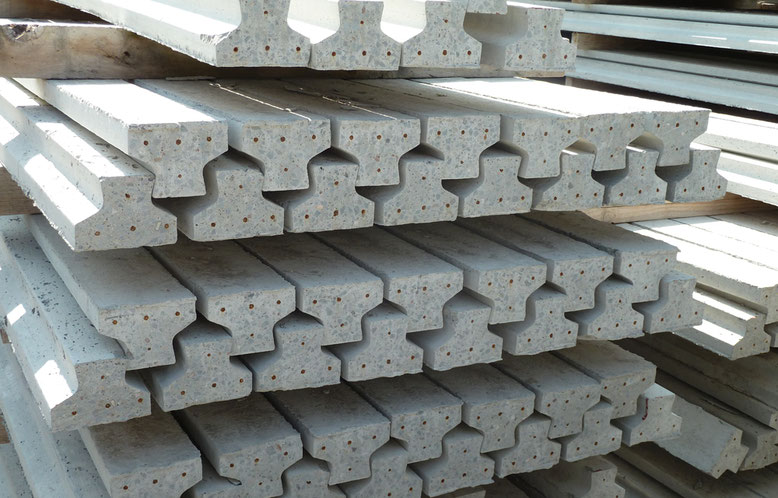
Precast concrete is a construction product produced by casting concrete in a reusable mold or "form" which is then cured in a controlled environment, transported to the construction site and maneuvered into place; examples include precast beams, and wall panels for tilt up construction.
Example: Precast concrete is a construction product produced by casting concrete in a reusable mold or "form" which is then cured in a controlled environment.
en: Concreto prefabricado
Prestressed concrete
noun
is a system devised to provide sufficient precompression in the concrete beam by tensioned steel wires, cables, or rods that under working conditions the concrete has no tensile stresses or the tensile stresses are so low that no visible cracking occurs.
Example: Prestressed concrete is used in a wide range of building and civil structures.
en: Hormigón pretensado
Reinforced concrete
noun
concrete in which steel is embedded in such a manner that the two materials act together in resisting forces.
Example: Roof systems REINFORCED CONCRETE roof slabs pre-cast concrete roof systems Services Thermal insulation
en: Concreto reforzado
Unreinforced concrete
noun
Ground supported slabs with light loading are frequently designed without reinforcing (unreinforced). Such slabs are referred to as membrane slabs, floating slabs, or filler slabs and range in thickness from as little as 4” to 8” depending on the supported loads.
Example: Concrete without reinforcement or reinforced only for shrinkage or temperature changes.